Learning Management System
A modern LMS for organizations that take learning seriously.
An adaptive learning platform for enterprises, training providers and academic institutions. Modular content, role-based pathways, native assessments and analytics — delivered as a white-labeled, scalable platform under your brand or ours.

6
Modules
4
Workflows
9+
Integrations
4
Security controls
4
AI capabilities
4
Deployment options
What's inside Vestval Learn
- Modular course architecture
- Skill graphs and competency tracking
- Native assessments and certifications
- Cohort, role and tenant management
- Enterprise SSO, SCORM / xAPI support
- Live analytics and reporting
Who it's for
The problem
Most LMS deployments fail not because the platform is wrong but because the platform is a content silo with no relationship to skills, roles, certifications or the rest of the organization. Learning happens; nothing compounds.
Executive overview
Vestval Learn is the learning system of record for enterprises, training providers and academic institutions that need learning to compound into measurable capability. Content, skills, assessments and certification live on one model — so time-to-competency, audit posture and learner outcomes stop being anecdotes and become live metrics leadership can act on.
Business outcomes
What leaders measure after go-live.
40–60%
Faster time-to-competency
Role-based pathways and native assessments compress onboarding and role transitions.
3×
Assessment throughput
Native, versioned assessments replace manual grading and third-party tools.
Audit-ready
Certification evidence
Tamper-evident credentials with immutable audit log — regulator questions answered in minutes, not weeks.
1 platform
Multi-tenant delivery
Training providers deliver every client program from a single deployment, per-tenant branded.
Core modules
Inside the Vestval Learn platform.
Module 1 of 6
Course & content
Modular authoring with drafts, review, versioning and rollback per module.
AI capabilities
AI where it earns its keep — governed by default.
Capability 1 of 4
Adaptive pathways
Learner mastery signals re-order lessons and surface remediation before drop-off.
Every AI decision carries confidence, source citations and — where the workflow demands it — a human review gate. See Trust Center for the governance model.
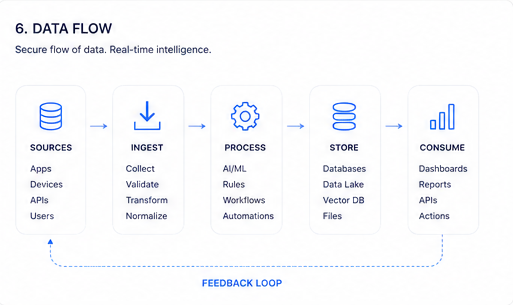
Architecture diagrams
How the platform is put together.
Deployment models
Meet the platform where your risk posture requires.
| Compare | Multi-tenant SaaS | Single-tenant SaaS | Private cloud | On-premise |
|---|---|---|---|---|
| Time to launch | Fastest | Fast | Planned | Governed |
| Data residency | Regional | Split | Your infra | Sovereign |
| Ops burden | We run it | Shared | You run it | Dedicated team |
| Best for | Speed | Balance | Control | Regulation |
APIs & developer experience
Open by construction.
REST & GraphQL APIs
Read/write access to learners, enrolments, progress, assessments and certifications.
xAPI event stream
Every learning statement emitted to your LRS or warehouse in real time.
SCORM 1.2 / 2004
Full authoring-tool interoperability plus native content coexisting with legacy packages.
Webhooks
Signed webhooks on enrolment, completion, certification and expiry events.
SDK & CLI
TypeScript SDK plus a CLI for CI-driven content publishing and migrations.
Scalability
Built to scale where it matters.
1M+ learners
Proven for national training programs and multi-country enterprises.
Multi-region
Horizontally scaled tenants across regions with residency guarantees.
10k concurrent assessments
Deterministic assessment runtime handles exam-day peaks without degradation.
Customization & white label
Configure the platform to your operating model.
White label
Per-tenant themes, custom domains, branded emails and identity providers.
Configurable pathways
Roles, cohorts and certification rules configured per program without engineering.
Custom fields & taxonomies
Extend learner, course and certification records to match your data model.
Content interop
SCORM, xAPI, PDF, video, docs, LTI — coexist with what you already have.
Migration guidance
How rollouts avoid the classic failure modes.
- 1
Content audit
Every course, module and assessment inventoried and mapped to the target model before any migration.
- 2
Certification evidence
Historical certifications imported as immutable evidence — no learner loses status during cutover.
- 3
Legacy read-only
Old LMS kept read-only during transition; users only see the new system once their program cuts over.
- 4
Phased program cutover
Programs migrated in waves — no big-bang, no assessment-day outages.
Comparison with alternatives
Vestval Learn vs. legacy and SaaS LMS
| Capability | Vestval Learn | Typical alternative |
|---|---|---|
| Native assessments | MCQ, free-text, scenario, code, proctored — all first-class | Third-party quiz tools bolted on; brittle for regulated exams |
| Skill graph | First-class; pathways, roles, certifications share one graph | Absent or a flat tag list; no compounding into capability |
| Multi-tenant / white-label | Per-tenant themes, domains and identity providers | Partial in SaaS LMS; absent in legacy LMS |
| Certification lifecycle | Issuance, expiry, re-cert, revocation, tamper-evident credentials | PDF certificates emailed at completion — expiry tracked in spreadsheets |
| Open data | xAPI event stream, webhooks, warehouse exports | Data locked in vendor warehouse; export a scoped project |
| Time-to-live | 6–12 weeks for enterprise programs | Multi-quarter for legacy; fast for SaaS but shallow |
Existing alternatives
What teams try first.
Legacy enterprise LMS
Heavy, slow to configure, mobile experience is an afterthought, assessments are brittle and the data is locked inside a vendor warehouse.
Modern SaaS LMS
Beautiful for small teams; struggles with multi-tenant, white-label, multi-jurisdiction certification and serious compliance workflows.
Stitched stack (Notion + Google Forms + Drive)
Cheap to start, impossible to certify against, has no audit posture, and falls over the moment regulators or learners scale.
Where they fall short
- Assessments are bolted on instead of native, so certification is unreliable.
- Skill and competency graphs don't exist, so learning never connects to roles or performance.
- Multi-tenant and white-label support is partial, so training providers can't run client deployments cleanly.
- Analytics tell you who logged in, not who is becoming competent.
Core capabilities
Everything Vestval Learn does.
Modular content architecture
Courses are composed of versioned modules, lessons and assessments — reusable across programs and tenants.
Skill & competency graph
Skills are first-class. Pathways, roles and certifications all reference the same skill nodes, so learning compounds into capability.
Native assessments
MCQ, free-text, scenario, code, file-upload and proctored variants — all natively, with a clean review workflow.
Cohorts, roles & tenants
Cohort enrollment, role-based pathways, multi-tenant isolation and per-tenant theming for training providers.
Certification engine
Issuance, expiry, re-certification, revocation and tamper-evident credentials for regulated programs.
Analytics for outcomes
Completion is a baseline metric. The platform reports time-to-competency, assessment reliability, drop-off and skill velocity.
Architecture overview
How the system is put together.
Layer 1 of 4
Multi-tenant core
Tenant isolation at the data layer; per-tenant theming, domains, identity providers and content libraries.
Workflows
End-to-end flows out of the box.
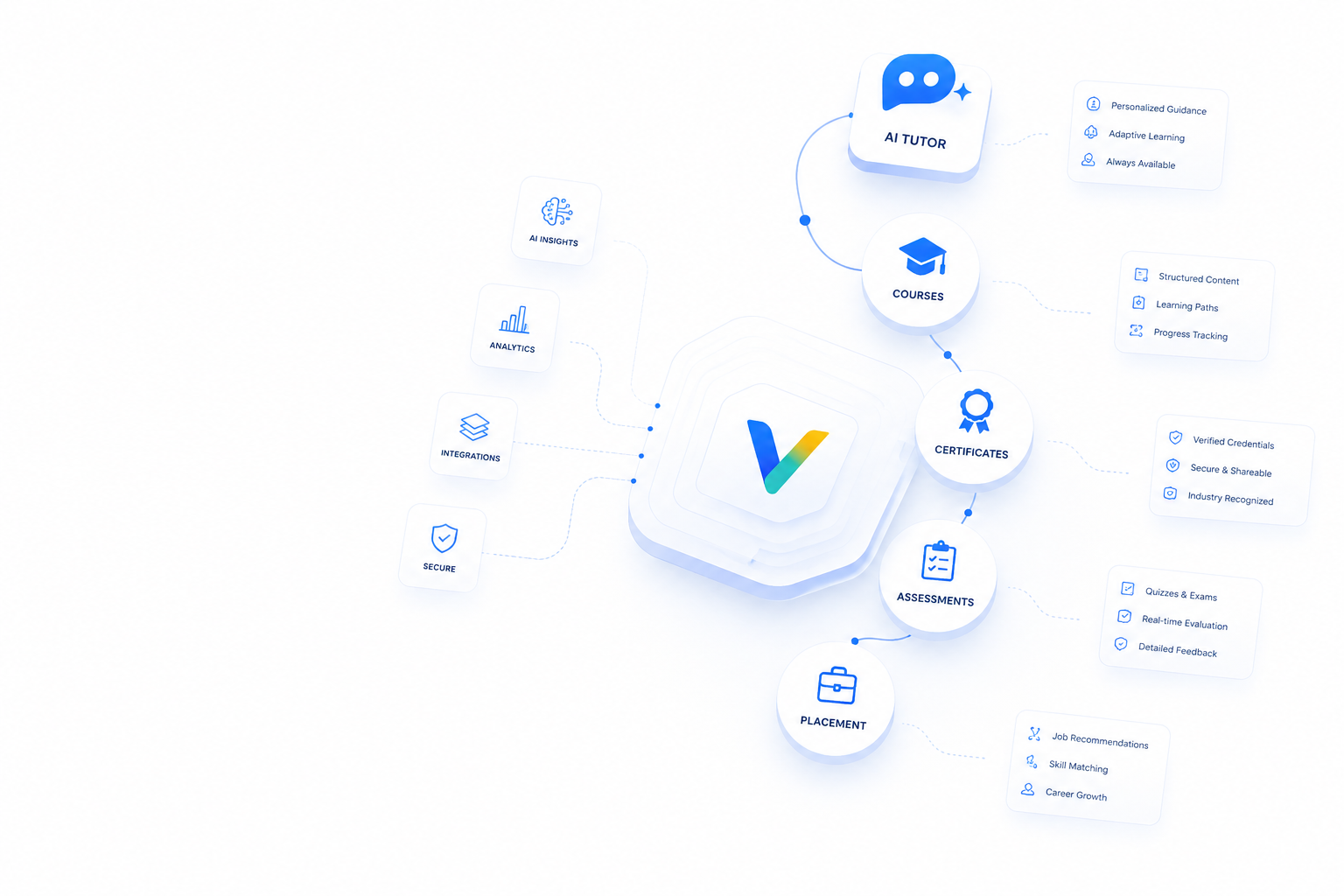
Step 1 · Learner journey
Enroll → pathway → modular learning → assessments → certification → re-certification windows — fully instrumented.
Inputs
Structured records, uploads and events captured from users or upstream systems.
Processing
Enroll → pathway → modular learning → assessments → certification → re-certification windows — fully instrumented.
Outputs
Actionable records, notifications and audit-ready artefacts delivered to the right owner.
Integrations
Bi-directional syncs to the systems Vestval Learn customers already operate.
Automation
Rules, schedules and event triggers keep the flow moving without manual chase.
AI
Assistive AI drafts, classifies and surfaces the next best action — with human-in-the-loop review.
Use cases
Where Vestval Learn earns its keep.
Enterprise L&D
Onboarding 5,000 new joiners across regions with role-based pathways and certification.
Outcome · Time-to-productive measurably compressed; certification posture audit-ready.
Training provider
Running white-labeled learner experiences across multiple client tenants.
Outcome · Single platform, multi-brand delivery, clean revenue and reporting per tenant.
University / academy
Hybrid programs with native assessments, proctoring and accreditation evidence.
Outcome · Modern learner experience without losing assessment integrity.
Regulated industry
Mandatory safety, compliance or product certification with expiry and floor-blocking enforcement.
Outcome · Continuous evidence collection; periodic audits become a non-event.
Industries served
Where this product fits best.
education
Native fit for universities, academies and training providers.
Industry page
healthcare
Clinician credentialing, mandatory training and audit evidence.
Industry page
manufacturing
Safety, operator certification and the plant skill matrix.
Industry page
finance
Regulatory training, advisor certification and audit trail.
Industry page
Integrations
Plays well with what you already have.
Vestval Learn connects with
- SSO (Okta, Azure AD, Google Workspace)
- SCIM provisioning
- SCORM 1.2 / 2004
- xAPI (Tin Can)
- HRMS (incl. Vestval People)
- Slack / MS Teams
- Calendar & video (Zoom, Meet, Teams)
- Stripe / payment gateways for training providers
- Webhooks & open APIs
Deep dives
Explore Vestval Learn in depth.
AI Tutor
A private, syllabus-aware tutor that meets each learner where they are — inside your programs, not in a generic chat window.
Learning Paths
Role- and skill-based pathways that turn a catalog of courses into a coherent journey to competency.
Assignments
Structured practice work — with rubrics, review workflow and evidence — inside every course.
Assessments
Native, defensible assessments — from MCQ to proctored — with a review workflow instructors trust.
Certificates
Tamper-evident credentials with issuance, expiry, re-certification and revocation — not just PDFs with a signature.
Corporate Learning
The enterprise L&D deployment of Vestval Learn — onboarding, compliance, upskilling and leadership programs in one platform.
Schools
Vestval Learn for K-12 — safe by design, curriculum-aware and built for teachers, not against them.
Colleges
Vestval Learn for colleges and universities — assessment-integrity-first, hybrid-native and built for accreditation.
Training
For training providers and academies — multi-tenant, white-label delivery of paid learning programs.
Placement
Turning learners into hires — an integrated placement pipeline that connects Vestval Learn programs to employers.
Security considerations
Engineered to survive a regulator's question.
Authentication
Who you are.
Identity & access
OIDC/SAML SSO, SCIM, role-based access, fine-grained per-program privacy controls.
Audit & evidence
Immutable audit log of assessment, certification and authoring actions.
Implementation approach
How rollouts actually work.
Phase 1 of 6
Discovery & migration audit — Vestval Learn
Two to three weeks to understand programs, content estate and certification history before any migration.
Related content
Read further.
FAQ
Vestval Learn — FAQs
- Yes — per-tenant theming, custom domains and identity providers are first-class. Training providers run multiple client tenants from one deployment.
Keep exploring
Resources for teams evaluating Vestval Learn.
Knowledge Center
Calculators
Assessments
Enterprise Solutions
Open Architecture
Standards-first. Nothing locked behind a vendor wall.
API First
Every capability reachable through a documented API.
AI Ready
Model, embedding and agent hooks across the platform.
Enterprise Security
SSO, SCIM, audit trails, role-based access.
Modular
Deploy only what you need. Extend where you must.
Scalable
Multi-tenant core, sized from pilot to group scale.
Cloud / Hybrid / On-Prem
Ship the same platform in the model your policy allows.
Zero Vendor Lock-in
Own your data, your schemas and your exit path.
Why enterprises choose Vestval
Six reasons enterprise buyers shortlist us.
You are not evaluating a feature list. You are underwriting a five-year platform decision. Here is how we think about that responsibility.
One platform, real depth
Vestval Learn unifies Learn, People, Flow and AI in a single enterprise workspace — instead of stitching five SaaS accounts, three data warehouses and a homegrown middle layer.
Built for regulated operations
SSO, SCIM, RBAC, audit trails, encryption in transit and at rest, and data residency options that satisfy security, legal and internal audit at the same time.
AI you can actually govern
Grounded on your data, scoped by role, evaluated against your policies. No mystery models writing memos to your board.
Zero vendor lock-in
Open schemas, documented APIs, exportable data and clear exit clauses. If you ever leave, you leave with everything.
Predictable economics
Modular pricing, no per-seat surprises on adjacent modules, and TCO models we're willing to defend line by line in a procurement meeting.
Delivery, not just software
A senior engagement team owns rollout, integration and adoption alongside your people — this is how enterprise programs actually succeed.
Customer outcomes
Illustrative outcomes from Vestval rollouts.
Illustrative ranges from real engagements. We do not publish customer names without permission — the numbers below are what good looks like, not marketing headlines.
3–5×
Faster deployment
Compared with in-house rebuilds of equivalent scope.
30–50%
Lower operational cost
Once redundant tools and manual glue work are consolidated.
40–70%
Reduced manual work
On targeted workflows automated through Vestval Flow.
10×
Better reporting cadence
Move from monthly PDFs to live, drillable dashboards.
2–3×
Higher employee adoption
One workspace beats five logins, every time.
Figures are illustrative ranges based on Vestval engagements. Actual outcomes vary by scope, integration surface and organisational readiness.
Why not build in-house
Building it yourself looks cheaper — until year two.
Almost every serious buyer runs the build-vs-buy question. Here is the honest side-by-side we walk clients through, including the parts vendors usually leave out.
| Consideration | Build in-house | Adopt Vestval |
|---|---|---|
| Time to first value | 9–18 months of engineering before line one of business value | Weeks to a working pilot on real data |
| Ongoing cost | Salaries, on-call, cloud spend, hiring risk — forever | Predictable licence + a defined engagement, no hidden headcount |
| Governance & audit | You design SSO, SCIM, audit trails, retention policies from scratch | Enterprise controls in the platform, not on a roadmap |
| AI capability | Model ops, evals, guardrails, prompt management — a new team | Grounded AI, scoped by role and data, governed by policy |
| Talent risk | Losing one senior engineer sets the roadmap back a quarter | A team of specialists, backed by product engineering |
| Exit optionality | You are the vendor. Migration is your problem. | Open schemas, documented exports, portable data |
How we compare
Vestval vs the alternatives.
Every enterprise buyer runs the same five comparisons. Rather than making you build the tables, here they are — expressed the way a serious evaluator would.
Vestval vs Traditional SaaS
See full comparisons →| Consideration | Traditional SaaS | Vestval |
|---|---|---|
| Architecture | Closed, opinionated, per-tenant only. | Open APIs, open schemas, deployable in your VPC. |
| AI | Bolted-on copilots, no governance surface. | Grounded, role-scoped, policy-controlled. |
| Commercials | Per-seat pricing that scales with headcount. | Modular capacity pricing sized to real usage. |
Vestval vs Fragmented multi-vendor stack
See full comparisons →| Consideration | Fragmented multi-vendor stack | Vestval |
|---|---|---|
| Data model | Five schemas, three integration teams, zero source of truth. | One data model across Learn, People, Flow and AI. |
| Ops cost | Middleware, glue code and reconciliations forever. | One platform to run, one team to escalate to. |
| Governance | Each vendor with its own auth and audit story. | One identity, one audit trail, one policy surface. |
Vestval vs Custom in-house build
See full comparisons →| Consideration | Custom in-house build | Vestval |
|---|---|---|
| Cost profile | Salaries + on-call + cloud, indefinitely. | Licence + defined engagement, budgetable multi-year. |
| Talent risk | One senior departure = a lost quarter. | A specialist team, backed by product engineering. |
| Governance | You design SSO, audit and retention yourself. | Enterprise controls in the platform on day one. |
Is this right for you?
Straight answers on where we fit — and where we don't.
We would rather lose a deal early than land a bad-fit customer. Here is a candid picture of where Vestval Learn is the right decision.
Right for you if
- You are consolidating multiple SaaS tools into one enterprise workspace.
- You need AI capabilities you can actually govern, not black-box copilots.
- You have regulated data and cannot compromise on residency or auditability.
- You want a delivery partner, not just a licence agreement.
When NOT to choose Vestval Learn
- You need a single-team, single-workflow point tool with no integration surface.
- You want the cheapest possible SaaS at any cost and will accept opaque AI.
- You are not ready to invest in change management or executive sponsorship.
- You require a hard-coded, on-prem-only stack with no cloud plane at all.
Who benefits most
- Groups with 500+ employees standardising on one operating platform.
- Regulated industries — BFSI, healthcare, public sector, energy.
- Enterprises with existing data warehouses, IdPs and ITSM to integrate against.
- CIOs looking to reduce vendor count without losing capability depth.
Evaluation criteria
Score every shortlisted platform on the same six axes.
A useful evaluation is boring on purpose. Use these axes for us and for every competitor you consider — even open source.
Architecture
Open APIs, extensibility, deployment flexibility, upgrade path.
Security & compliance
Identity, data protection, audit, residency, DPIA readiness.
AI governance
Grounding, evaluation, opt-out, model transparency, policy alignment.
Total cost of ownership
Licence + implementation + run cost + exit cost — not just the sticker price.
Delivery & support
Named team, escalation path, engagement model, roadmap partnership.
Roadmap alignment
Where the vendor is investing next, and whether that aligns with your three-year plan.
Buying checklist
Six things to have in place before signing anything — with anyone.
This is the checklist we quietly use to qualify readiness on our own side. Sharing it openly usually saves a quarter of wasted evaluation time.
- 01
Executive sponsor identified and outcome hypothesis documented.
- 02
Current-state inventory of tools, data sources and integrations completed.
- 03
Security, legal and procurement stakeholders briefed early — not at the end.
- 04
Success measures agreed in writing, with a 90-day and 12-month checkpoint.
- 05
Rollout scope narrowed to a real business area, not a whole-company big bang.
- 06
Migration and change-management ownership assigned on the customer side.
Risk mitigation
Six enterprise risks — with how Vestval mitigates each.
The mistake in most RFPs is asking about features and forgetting to ask about failure modes. Here is how we design the failure modes out.
| Risk | How we mitigate it |
|---|---|
| Vendor viability | Modular architecture, source escrow options and documented data exports — your business is not tied to our balance sheet. |
| Scope creep | SOWs with defined phases, change-control gates and re-scoping checkpoints. |
| Change fatigue | Enablement built into every rollout — playbooks, champions, in-product guidance, quarterly reviews. |
| Integration debt | Reference integrations for major HRIS, IdP, ITSM and warehouse platforms — you don't re-invent the pipe. |
| AI misuse | Role-scoped grounding, evaluation registries, policy-controlled surfaces and full audit trails. |
| Exit cost | Open schemas, standards-based exports and portability guarantees written into the contract. |
ROI expectations
What good looks like — expressed as ranges, not promises.
Illustrative ranges from Vestval engagements. We publish these openly so procurement can pressure-test them in a scoping call.
Time to first production value
Weeks, not quarters
Illustrative — depends on scope and readiness.
Licence displacement
3–6 adjacent tools consolidated
Typical Vestval One rollout.
Manual work reduction
30–60% on targeted workflows
Measured against pre-Vestval baseline.
Reporting cycle time
Days → hours
Where Flow and analytics replace hand-rolled pipelines.
Related across Vestval
Explore
Products
Vestval One, Learn, People, Flow and AI in one platform.
Explore
Solutions
Outcome-led solutions built on the Vestval stack.
Explore
Industries
Reference architectures tuned to your sector.
Proof
Customer stories
Outcomes and rollout patterns from real engagements.
Delivery
Implementation
The five-phase methodology used on every rollout.
Build
Documentation
APIs, SDKs and integration guides.
Trust
Trust Center
Security, compliance and AI governance in one place.
Model
ROI calculators
Model licence displacement, payback and TCO.
Decide
Buying guides
How to evaluate and buy platforms like this one.
Where to next
Never a dead end — pick the next useful step.
Book a demo
See Vestval on your data with a senior engineer — no scripted deck.
Talk to a solution architect
A working session on your stack, constraints and target state.
Calculate ROI
Model payback, licence displacement and time-to-value in minutes.
Compare Vestval
Feature, architecture and pricing comparisons against your shortlist.
Implementation guide
Phase-by-phase methodology used on every enterprise engagement.
Explore documentation
APIs, SDKs, integration guides and developer references.
Customer stories
Outcomes and rollout patterns from real Vestval engagements.
Industry blueprint
Reference architecture and KPIs tuned to your sector.
Talk to a solution architect
Ready to see Vestval Learn on your data?
A senior member of our team will walk you through Vestval Learn on a scenario that matches your operating reality — not a scripted demo. No hard sell, no obligation.
Part of Vestval One
Vestval Learn runs on Vestval One — the intelligent operating system for the enterprise.
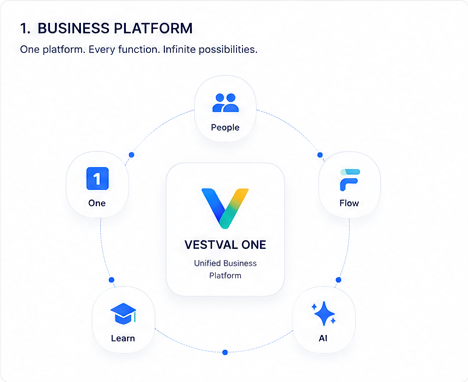
Vestval One is the flagship platform that unifies Learn, People, Flow, AI and Robotics Lab. Identity, data, workflows, analytics and AI are shared across every product — so Learn does not live in a silo. It plugs into the same governance, the same audit trail and the same intelligence layer as the rest of the stack.
- Unified identitySingle SSO, SCIM and role model across every Vestval product.
- Shared data planeCommon event stream, warehouse-friendly exports, one lineage.
- Cross-product workflowsLearning, HR, operations and AI orchestrated end-to-end.
- Intelligence layerVestval AI observes every product and closes the loop.
Other products in the Vestval stack
All productsHuman Resource Management
Vestval People
HRMS engineered for modern workforces and modern operations.
Enterprise Resource Planning
Vestval One
A unified operating system for finance, operations and resources.
Workflow & Process Automation
Vestval Flow
Operational workflow automation that quietly runs the business.
Personal Financial Operating System
Vestval AI
An AI-powered consumer financial operating system — independent by design.