Human Resource Management
HRMS engineered for modern workforces and modern operations.
An end-to-end human resource platform — employee lifecycle, performance, compliance, payroll workflows and people analytics. Built to scale from 50 to 50,000 employees, available white-labeled or under Vestval.
6
Modules
4
Workflows
10+
Integrations
4
Security controls
4
AI capabilities
3
Deployment options
What's inside Vestval People
- Org graph and people directory
- Performance, OKRs and growth reviews
- Attendance, leave and shift management
- Payroll workflows and compliance
- Role-based access and audit trails
- Insights for leaders and HR ops
Who it's for
The problem
HR teams accumulate tools the way garages accumulate cables. ATS here, performance there, payroll in a third place, an org chart in slides. People data is fragmented, performance is theatre and leadership analytics arrive in quarterly PDFs that nobody trusts.
Executive overview
Vestval People is the human resource system of record for scaling businesses. One canonical org graph powers lifecycle, performance, compensation and compliance — so HR stops reconciling four overlapping tools and leadership finally reads the same numbers as the CFO.
Business outcomes
What leaders measure after go-live.
1 org graph
Reconciled truth
Every workflow, report and access decision reads from a single reconciled directory.
50%
Faster performance cycles
Continuous check-ins and calibration compress the annual review from months into weeks.
Real-time
People analytics
Headcount, attrition, comp drift and span-of-control — live, not quarterly.
Multi-jurisdiction
Compliance posture
Regional rule packs keep statutory posture audit-ready across India, US, UK and APAC.
Core modules
Inside the Vestval People platform.
Module 1 of 6
Directory & org graph
Canonical employee, position and reporting model with change-event versioning.
AI capabilities
AI where it earns its keep — governed by default.
Capability 1 of 4
Attrition risk
Model surfaces at-risk cohorts with explanations — never a black-box score.
Every AI decision carries confidence, source citations and — where the workflow demands it — a human review gate. See Trust Center for the governance model.
Architecture diagrams
How the platform is put together.
Deployment models
Meet the platform where your risk posture requires.
| Compare | Multi-tenant SaaS | Single-tenant SaaS | Private cloud |
|---|---|---|---|
| Time to launch | Fastest | Fast | Planned |
| Data residency | Regional | Split | Your infra |
| Ops burden | We run it | Shared | You run it |
| Best for | Speed | Balance | Control |
APIs & developer experience
Open by construction.
REST & GraphQL APIs
Employees, positions, org graph, performance, compensation and lifecycle events.
SCIM 2.0 provisioning
Bidirectional sync with Okta, Azure AD and downstream apps.
Webhooks
Signed webhooks on hire, transfer, promotion, exit and compensation changes.
Payroll bridge
Standard pre-payroll export and post-payroll reconciliation for the major regional engines.
Scalability
Built to scale where it matters.
50 → 50,000
Same platform scales from startup to global enterprise.
Multi-country
Per-jurisdiction rule packs with versioned regulatory updates.
Field-level access
Compensation, ID and health fields restricted by role and purpose at data plane.
Customization & white label
Configure the platform to your operating model.
White label
Per-tenant theme, custom domain and branded employee experience.
Configurable workflows
Approval chains, escalation and document templates configured per entity.
Custom fields & taxonomies
Extend employee and position records without forking.
Localization
Language, currency and statutory pack per jurisdiction.
Migration guidance
How rollouts avoid the classic failure modes.
- 1
Org graph reconciliation
Competing sources of org truth reconciled into one canonical graph before anything else moves.
- 2
Historical data import
Employment, comp and lifecycle history imported with lineage — nothing lost during cutover.
- 3
Region-by-region rollout
Multi-jurisdiction cutovers sequenced by region with legal review per jurisdiction.
- 4
Payroll bridge, not replace
Existing payroll engines integrated first; replacement only if the business case is clear.
Comparison with alternatives
Vestval People vs. legacy HRIS and modern HR SaaS
| Capability | Vestval People | Typical alternative |
|---|---|---|
| Canonical org graph | First-class model; every module reads from it | Directory + org chart drift constantly across tools |
| Performance ↔ compensation | Wired together with calibration and fairness checks | Separate systems; growth and reward disconnected |
| Multi-jurisdiction compliance | Rule packs for IN / US / UK / APAC with versioned updates | Deep in home region; patchwork elsewhere |
| Field-level access | Enforced at data plane, per role and purpose | Screen-level only; sensitive data leaks via exports |
| Analytics | Live headcount, attrition, comp drift, DEI — drill-through | Quarterly PDFs assembled from exports |
| Time-to-live | 6–12 weeks mid-market; region-by-region enterprise | Multi-quarter partner-led implementations |
Existing alternatives
What teams try first.
Legacy HRIS (SAP, Oracle, etc.)
Comprehensive on paper, painful to configure, mobile experience is weak and partner-led implementations stretch into quarters.
Modern HR SaaS (BambooHR, Rippling, etc.)
Excellent in their core region; gaps in multi-jurisdiction compliance, performance depth and enterprise governance.
Best-of-breed stack
Four overlapping tools, three sources of org truth, and a payroll handoff that breaks every time someone moves regions.
Where they fall short
- Org graph isn't canonical, so every system disagrees about who reports to whom.
- Performance and compensation live apart, so growth conversations are disconnected from reward.
- Compliance posture is region-by-region patchwork, with statutory rules buried in spreadsheets.
- Analytics are descriptive at best — leadership cannot see attrition risk, hiring velocity or compensation drift in time to act.
Core capabilities
Everything Vestval People does.
Canonical org graph
One reconciled org truth — every workflow, report and access decision reads from it.
Employee lifecycle
Hire, onboard, transfer, promote, exit — modelled as workflows with auditable approvals.
Performance & OKRs
Continuous performance with goals, check-ins, calibration and growth-track visibility.
Attendance, leave & shifts
Biometric, geo and self-attendance with shift rosters and statutory wage protection.
Payroll workflows
Pre-payroll inputs, attendance lock, statutory deductions, payslips and post-payroll reconciliation — integrated with existing payroll engines where you prefer.
People analytics
Headcount, attrition, hiring velocity, compensation drift, span-of-control and DEI dashboards with drill-through.
Architecture overview
How the system is put together.
Layer 1 of 4
People data plane
Canonical employee, position and org models with strict change-event versioning.
Workflows
End-to-end flows out of the box.
Step 1 · Hire to onboard
Offer rollout, document collection, statutory inputs, asset assignment, day-one checklist — all automated with manager and IT handoffs.
Inputs
Structured records, uploads and events captured from users or upstream systems.
Processing
Offer rollout, document collection, statutory inputs, asset assignment, day-one checklist — all automated with manager and IT handoffs.
Outputs
Actionable records, notifications and audit-ready artefacts delivered to the right owner.
Integrations
Bi-directional syncs to the systems Vestval People customers already operate.
Automation
Rules, schedules and event triggers keep the flow moving without manual chase.
AI
Assistive AI drafts, classifies and surfaces the next best action — with human-in-the-loop review.
Use cases
Where Vestval People earns its keep.
Scale-up (200–2,000)
Replacing four overlapping HR tools with a single source of truth.
Outcome · Org graph reconciled, leadership analytics live, three of four legacy tools retired in year one.
Mid-market enterprise (2,000–20,000)
Multi-region HR with statutory compliance and serious performance discipline.
Outcome · Region-by-region cutover; compliance posture audit-ready; performance cycle compressed materially.
Service business (BPO, ITES, retail)
Shift, attendance and wage compliance across hundreds of locations.
Outcome · Frontline visibility for area managers; statutory exposure dramatically reduced.
Distributed team
Async hiring, performance and growth across geographies.
Outcome · Manager experience standardized regardless of where employees sit.
Industries served
Where this product fits best.
technology
Performance, compensation and growth discipline for scale-ups.
Industry page
retail
Store labor planning and frontline workforce.
Industry page
manufacturing
Shop-floor shift, attendance and statutory compliance.
Industry page
healthcare
Clinician credentialing and multi-clinic workforce.
Industry page
Integrations
Plays well with what you already have.
Vestval People connects with
- SSO (Okta, Azure AD, Google Workspace)
- SCIM provisioning
- Payroll engines (regional)
- Background-check providers
- ATS systems
- Calendar & video
- Slack / MS Teams
- Vestval Learn for L&D
- Vestval Flow for cross-functional approvals
- Open APIs and webhooks
Deep dives
Explore Vestval People in depth.
Recruitment
An applicant tracking and hiring workflow built for real hiring teams — not a form-builder pretending to be an ATS.
Attendance
Accurate attendance across offices, remote, shift and field work — with the audit trail regulators expect.
Leave
Leave policies that reflect how your company actually works — with clear balances, approvals and audit.
Payroll
Accurate, on-time payroll with the audit trail your finance and compliance teams need.
Performance
Performance management that produces evidence and growth — not paperwork.
Employee Self Service
A single, friendly place for employees to do the HR tasks they actually need — without a ticket.
Organization
The organizational graph — people, roles, reporting lines, entities and locations — as a living, trustworthy source of truth.
Analytics
People analytics that produce decisions — attrition, cost, coverage, engagement and DEI — not vanity dashboards.
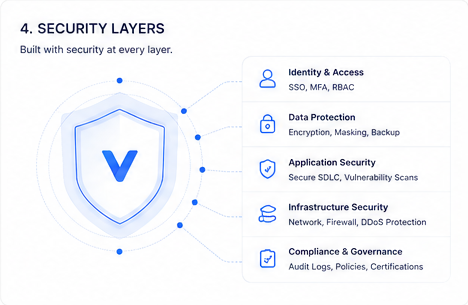
Security considerations
Engineered to survive a regulator's question.
Authorization
What you can do.
Field-level access control
Compensation, ID and health fields restricted by role and purpose.
Implementation approach
How rollouts actually work.
Phase 1 of 6
Org graph reconciliation — Vestval People
The unglamorous first phase — reconcile competing sources of org truth into one canonical graph.
Related content
Read further.
FAQ
Vestval People — FAQs
- We can — but we usually don't. Integrating with your existing payroll engine is lower-risk and faster. HR is the system of record; payroll is the system of execution.
Keep exploring
Resources for teams evaluating Vestval People.
Knowledge Center
Assessments
Buying Guides
Enterprise Solutions
Open Architecture
Standards-first. Nothing locked behind a vendor wall.
API First
Every capability reachable through a documented API.
AI Ready
Model, embedding and agent hooks across the platform.
Enterprise Security
SSO, SCIM, audit trails, role-based access.
Modular
Deploy only what you need. Extend where you must.
Scalable
Multi-tenant core, sized from pilot to group scale.
Cloud / Hybrid / On-Prem
Ship the same platform in the model your policy allows.
Zero Vendor Lock-in
Own your data, your schemas and your exit path.
Why enterprises choose Vestval
Six reasons enterprise buyers shortlist us.
You are not evaluating a feature list. You are underwriting a five-year platform decision. Here is how we think about that responsibility.
One platform, real depth
Vestval People unifies Learn, People, Flow and AI in a single enterprise workspace — instead of stitching five SaaS accounts, three data warehouses and a homegrown middle layer.
Built for regulated operations
SSO, SCIM, RBAC, audit trails, encryption in transit and at rest, and data residency options that satisfy security, legal and internal audit at the same time.
AI you can actually govern
Grounded on your data, scoped by role, evaluated against your policies. No mystery models writing memos to your board.
Zero vendor lock-in
Open schemas, documented APIs, exportable data and clear exit clauses. If you ever leave, you leave with everything.
Predictable economics
Modular pricing, no per-seat surprises on adjacent modules, and TCO models we're willing to defend line by line in a procurement meeting.
Delivery, not just software
A senior engagement team owns rollout, integration and adoption alongside your people — this is how enterprise programs actually succeed.
Customer outcomes
Illustrative outcomes from Vestval rollouts.
Illustrative ranges from real engagements. We do not publish customer names without permission — the numbers below are what good looks like, not marketing headlines.
3–5×
Faster deployment
Compared with in-house rebuilds of equivalent scope.
30–50%
Lower operational cost
Once redundant tools and manual glue work are consolidated.
40–70%
Reduced manual work
On targeted workflows automated through Vestval Flow.
10×
Better reporting cadence
Move from monthly PDFs to live, drillable dashboards.
2–3×
Higher employee adoption
One workspace beats five logins, every time.
Figures are illustrative ranges based on Vestval engagements. Actual outcomes vary by scope, integration surface and organisational readiness.
Why not build in-house
Building it yourself looks cheaper — until year two.
Almost every serious buyer runs the build-vs-buy question. Here is the honest side-by-side we walk clients through, including the parts vendors usually leave out.
| Consideration | Build in-house | Adopt Vestval |
|---|---|---|
| Time to first value | 9–18 months of engineering before line one of business value | Weeks to a working pilot on real data |
| Ongoing cost | Salaries, on-call, cloud spend, hiring risk — forever | Predictable licence + a defined engagement, no hidden headcount |
| Governance & audit | You design SSO, SCIM, audit trails, retention policies from scratch | Enterprise controls in the platform, not on a roadmap |
| AI capability | Model ops, evals, guardrails, prompt management — a new team | Grounded AI, scoped by role and data, governed by policy |
| Talent risk | Losing one senior engineer sets the roadmap back a quarter | A team of specialists, backed by product engineering |
| Exit optionality | You are the vendor. Migration is your problem. | Open schemas, documented exports, portable data |
How we compare
Vestval vs the alternatives.
Every enterprise buyer runs the same five comparisons. Rather than making you build the tables, here they are — expressed the way a serious evaluator would.
Vestval vs Traditional SaaS
See full comparisons →| Consideration | Traditional SaaS | Vestval |
|---|---|---|
| Architecture | Closed, opinionated, per-tenant only. | Open APIs, open schemas, deployable in your VPC. |
| AI | Bolted-on copilots, no governance surface. | Grounded, role-scoped, policy-controlled. |
| Commercials | Per-seat pricing that scales with headcount. | Modular capacity pricing sized to real usage. |
Vestval vs Fragmented multi-vendor stack
See full comparisons →| Consideration | Fragmented multi-vendor stack | Vestval |
|---|---|---|
| Data model | Five schemas, three integration teams, zero source of truth. | One data model across Learn, People, Flow and AI. |
| Ops cost | Middleware, glue code and reconciliations forever. | One platform to run, one team to escalate to. |
| Governance | Each vendor with its own auth and audit story. | One identity, one audit trail, one policy surface. |
Vestval vs Custom in-house build
See full comparisons →| Consideration | Custom in-house build | Vestval |
|---|---|---|
| Cost profile | Salaries + on-call + cloud, indefinitely. | Licence + defined engagement, budgetable multi-year. |
| Talent risk | One senior departure = a lost quarter. | A specialist team, backed by product engineering. |
| Governance | You design SSO, audit and retention yourself. | Enterprise controls in the platform on day one. |
Is this right for you?
Straight answers on where we fit — and where we don't.
We would rather lose a deal early than land a bad-fit customer. Here is a candid picture of where Vestval People is the right decision.
Right for you if
- You are consolidating multiple SaaS tools into one enterprise workspace.
- You need AI capabilities you can actually govern, not black-box copilots.
- You have regulated data and cannot compromise on residency or auditability.
- You want a delivery partner, not just a licence agreement.
When NOT to choose Vestval People
- You need a single-team, single-workflow point tool with no integration surface.
- You want the cheapest possible SaaS at any cost and will accept opaque AI.
- You are not ready to invest in change management or executive sponsorship.
- You require a hard-coded, on-prem-only stack with no cloud plane at all.
Who benefits most
- Groups with 500+ employees standardising on one operating platform.
- Regulated industries — BFSI, healthcare, public sector, energy.
- Enterprises with existing data warehouses, IdPs and ITSM to integrate against.
- CIOs looking to reduce vendor count without losing capability depth.
Evaluation criteria
Score every shortlisted platform on the same six axes.
A useful evaluation is boring on purpose. Use these axes for us and for every competitor you consider — even open source.
Architecture
Open APIs, extensibility, deployment flexibility, upgrade path.
Security & compliance
Identity, data protection, audit, residency, DPIA readiness.
AI governance
Grounding, evaluation, opt-out, model transparency, policy alignment.
Total cost of ownership
Licence + implementation + run cost + exit cost — not just the sticker price.
Delivery & support
Named team, escalation path, engagement model, roadmap partnership.
Roadmap alignment
Where the vendor is investing next, and whether that aligns with your three-year plan.
Buying checklist
Six things to have in place before signing anything — with anyone.
This is the checklist we quietly use to qualify readiness on our own side. Sharing it openly usually saves a quarter of wasted evaluation time.
- 01
Executive sponsor identified and outcome hypothesis documented.
- 02
Current-state inventory of tools, data sources and integrations completed.
- 03
Security, legal and procurement stakeholders briefed early — not at the end.
- 04
Success measures agreed in writing, with a 90-day and 12-month checkpoint.
- 05
Rollout scope narrowed to a real business area, not a whole-company big bang.
- 06
Migration and change-management ownership assigned on the customer side.
Risk mitigation
Six enterprise risks — with how Vestval mitigates each.
The mistake in most RFPs is asking about features and forgetting to ask about failure modes. Here is how we design the failure modes out.
| Risk | How we mitigate it |
|---|---|
| Vendor viability | Modular architecture, source escrow options and documented data exports — your business is not tied to our balance sheet. |
| Scope creep | SOWs with defined phases, change-control gates and re-scoping checkpoints. |
| Change fatigue | Enablement built into every rollout — playbooks, champions, in-product guidance, quarterly reviews. |
| Integration debt | Reference integrations for major HRIS, IdP, ITSM and warehouse platforms — you don't re-invent the pipe. |
| AI misuse | Role-scoped grounding, evaluation registries, policy-controlled surfaces and full audit trails. |
| Exit cost | Open schemas, standards-based exports and portability guarantees written into the contract. |
ROI expectations
What good looks like — expressed as ranges, not promises.
Illustrative ranges from Vestval engagements. We publish these openly so procurement can pressure-test them in a scoping call.
Time to first production value
Weeks, not quarters
Illustrative — depends on scope and readiness.
Licence displacement
3–6 adjacent tools consolidated
Typical Vestval One rollout.
Manual work reduction
30–60% on targeted workflows
Measured against pre-Vestval baseline.
Reporting cycle time
Days → hours
Where Flow and analytics replace hand-rolled pipelines.
Related across Vestval
Explore
Products
Vestval One, Learn, People, Flow and AI in one platform.
Explore
Solutions
Outcome-led solutions built on the Vestval stack.
Explore
Industries
Reference architectures tuned to your sector.
Proof
Customer stories
Outcomes and rollout patterns from real engagements.
Delivery
Implementation
The five-phase methodology used on every rollout.
Build
Documentation
APIs, SDKs and integration guides.
Trust
Trust Center
Security, compliance and AI governance in one place.
Model
ROI calculators
Model licence displacement, payback and TCO.
Decide
Buying guides
How to evaluate and buy platforms like this one.
Where to next
Never a dead end — pick the next useful step.
Book a demo
See Vestval on your data with a senior engineer — no scripted deck.
Talk to a solution architect
A working session on your stack, constraints and target state.
Calculate ROI
Model payback, licence displacement and time-to-value in minutes.
Compare Vestval
Feature, architecture and pricing comparisons against your shortlist.
Implementation guide
Phase-by-phase methodology used on every enterprise engagement.
Explore documentation
APIs, SDKs, integration guides and developer references.
Customer stories
Outcomes and rollout patterns from real Vestval engagements.
Industry blueprint
Reference architecture and KPIs tuned to your sector.
Talk to a solution architect
Ready to see Vestval People on your data?
A senior member of our team will walk you through Vestval People on a scenario that matches your operating reality — not a scripted demo. No hard sell, no obligation.
Part of Vestval One
Vestval People runs on Vestval One — the intelligent operating system for the enterprise.
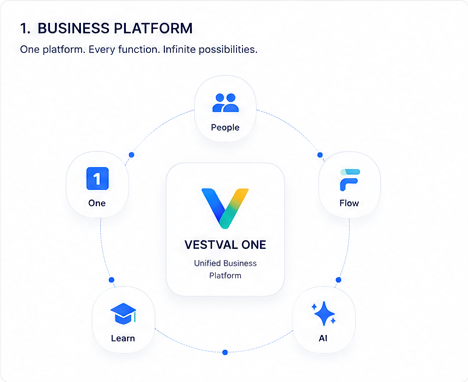
Vestval One is the flagship platform that unifies Learn, People, Flow, AI and Robotics Lab. Identity, data, workflows, analytics and AI are shared across every product — so People does not live in a silo. It plugs into the same governance, the same audit trail and the same intelligence layer as the rest of the stack.
- Unified identitySingle SSO, SCIM and role model across every Vestval product.
- Shared data planeCommon event stream, warehouse-friendly exports, one lineage.
- Cross-product workflowsLearning, HR, operations and AI orchestrated end-to-end.
- Intelligence layerVestval AI observes every product and closes the loop.
Other products in the Vestval stack
All productsLearning Management System
Vestval Learn
A modern LMS for organizations that take learning seriously.
Enterprise Resource Planning
Vestval One
A unified operating system for finance, operations and resources.
Workflow & Process Automation
Vestval Flow
Operational workflow automation that quietly runs the business.
Personal Financial Operating System
Vestval AI
An AI-powered consumer financial operating system — independent by design.